
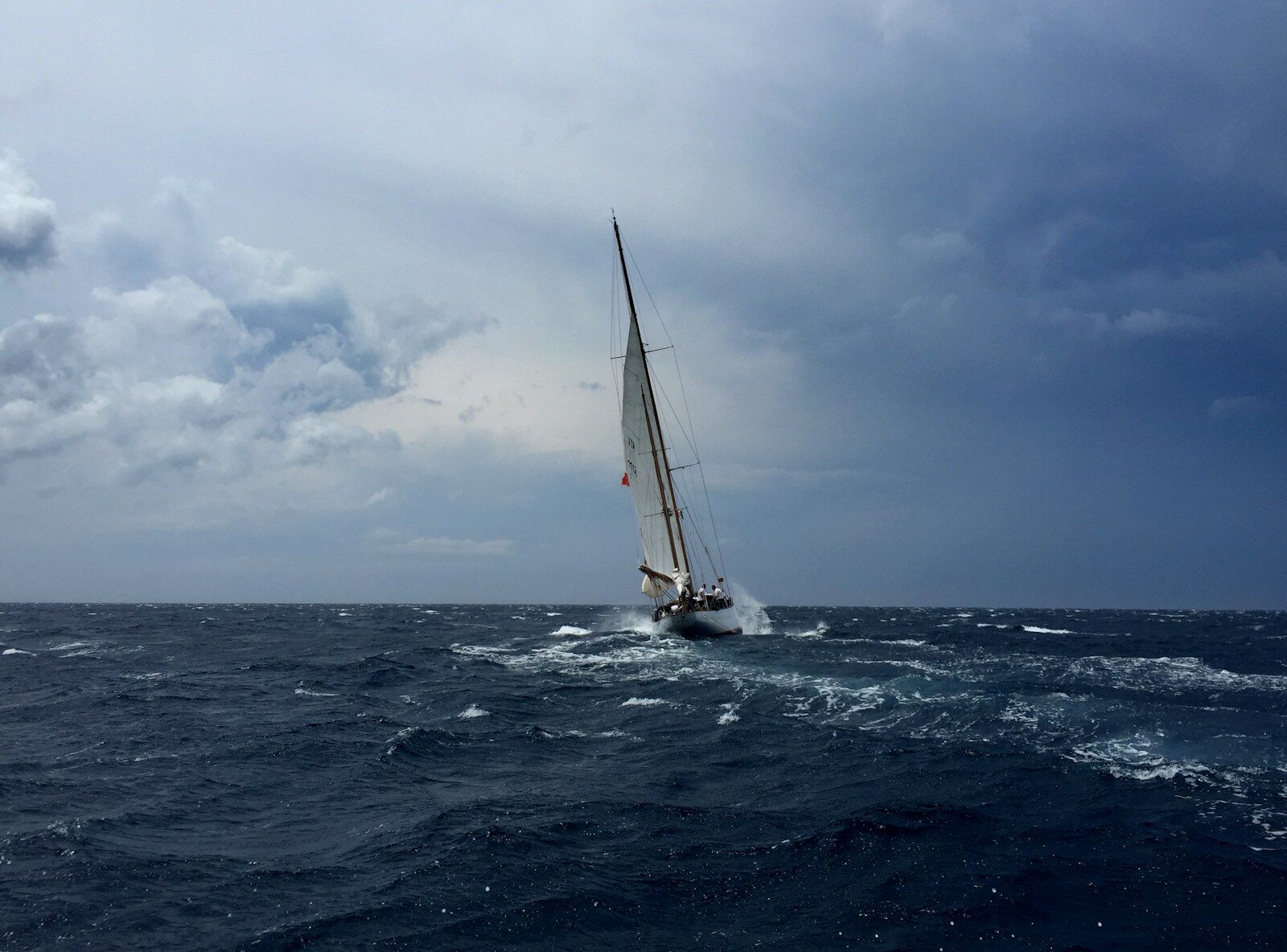
The Bayesian sank because a sudden, hurricane-force downburst knocked it flat while it lay at anchor with its sails down, a condition in which the yacht was vulnerable to capsizing but which had never been assessed, so the crew had no warning of the risk. That is the central finding of the UK’s Marine Accident Investigation Branch (MAIB), which published its final report on Thursday 19 November 2026.
The 56-metre superyacht went down off Porticello, near Palermo in Sicily, in the early hours of 19 August 2024. Seven of the 22 people on board died: the British technology entrepreneur Mike Lynch and his 18-year-old daughter Hannah, Jonathan and Judy Bloomer, Chris and Neda Morvillo, and the yacht’s chef, Recaldo Thomas.
What did the MAIB report find?
The report makes two main findings. First, the yacht had a weakness that nobody had spotted. With no sails set and its retractable centreboard (a large underwater fin that helps keep a sailing boat stable) raised, Bayesian could be knocked over by severe winds. Its approved stability book covered how the boat behaved under sail, but said nothing about this “motoring” condition, which is the one it was in at anchor that night. In the MAIB’s words, that left the crew “unaware of a critical risk to the vessel”.
Second, the weather that hit the yacht was not clearly forecast. The forecast for the area was broadly right about thunderstorms, but it did not flag the risk of a downburst, a violent column of air that drops out of a storm and spreads across the sea. No weather warning was in place for the area.
How fast did it happen?
Very fast. The MAIB says calm conditions turned into winds of at least 68 knots (about 78mph) in around 14 minutes. When the strongest gust arrived at 4.06am, it pushed the yacht onto its side in under 15 seconds. Once it heeled past about 73 degrees, the report says, it could not right itself. Water flooded in and it sank in about 50 metres of water.
Fifteen people escaped. None of the liferafts inflated or released automatically, so a crew member swam back to free one by hand. The survivors were picked up by a nearby yacht, the Sir Robert Baden-Powell.
Does the report blame the crew?
No, but that is not what MAIB reports are for. The branch investigates accidents involving UK-flagged ships to prevent them happening again, and its reports are not designed to decide who is legally responsible. Its conclusion is that the crew could not take account of a risk that had never been identified for them.
That is where it differs from reports coming out of Italy. Italian prosecutors are running a separate criminal investigation, and Italian media have reported that experts there point to crew error rather than the boat’s design. That process has not finished, no one has been charged, and its findings have not been tested in court.
What happens next?
The MAIB has made recommendations to four bodies:
- The Red Ensign Group, which sets the code for large British-flagged yachts, should study the weaknesses found and update its rules.
- The Maritime and Coastguard Agency should add the risks of downbursts and severe gusts to yacht masters’ training.
- The Met Office should raise with the World Meteorological Organization how rare but extreme weather is shown in forecast data.
- The UK Hydrographic Office should update its guidance for sailors on this kind of weather.
It has also issued a safety flyer to the yachting industry. Separately, UK inquests into the deaths of the four British victims are ongoing, and the Maritime and Coastguard Agency is carrying out its own investigation.
What do we still not know?
- The outcome of the Italian case. Prosecutors’ expert evidence has been reported in the media but has not been tested in court.
- Exactly why some guests could not get out. The MAIB says it did not get full access to the wreck straight after it was raised, and that limited what it could establish about the final minutes inside.
- Whether yacht rules will change. The recommendations are not binding until the bodies involved act on them.
The bottom line is that, according to the UK’s official investigators, Bayesian was caught out by a rare, extreme gust while in a condition its own paperwork never warned about. That is the main lesson the report wants yacht owners, designers and forecasters to take away.
Sources
- MAIB: Foundering of the sailing yacht Bayesian with the loss of seven lives (GOV.UK)
- MAIB: Bayesian report and safety flyer published (GOV.UK)
- The Guardian: Mike Lynch’s superyacht had unidentified vulnerability to high winds, report finds
- Yachting World: Report finds crew were unaware of critical risk before superyacht’s fatal capsize
- The Telegraph: Bayesian yacht crew not to blame for disaster, investigators rule