
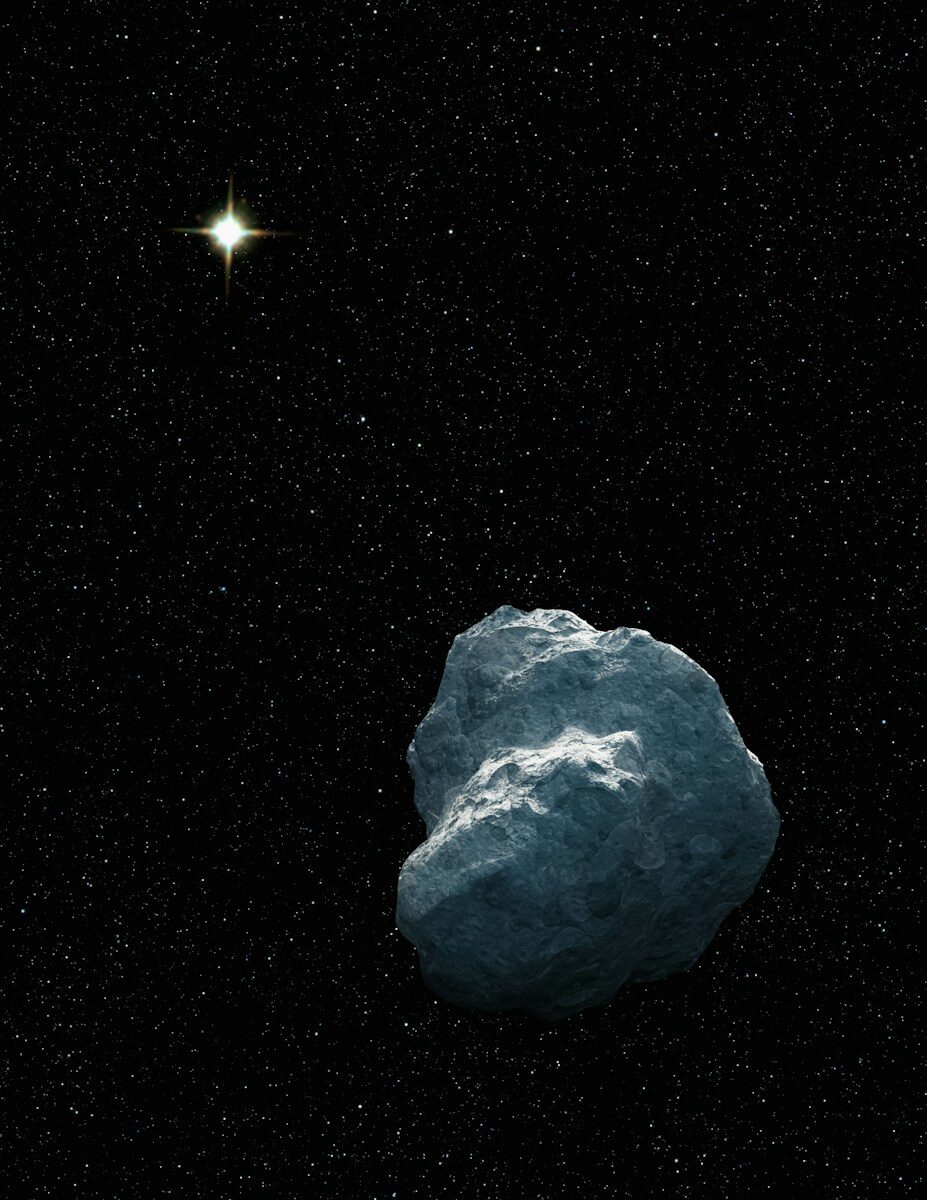
NASA’s Lucy spacecraft has reached the region occupied by Jupiter’s leading Trojan asteroids, five years after leaving Earth. The milestone places the mission on the approach to a sequence of close encounters that will examine bodies thought to preserve clues from the Solar System’s formation.
Lucy has travelled about 2.2 billion miles along a carefully planned route using planetary gravity assists. Reaching the Trojan region is not the same as arriving at one asteroid: the objects are spread along Jupiter’s orbit, and the spacecraft will continue navigating towards individual targets.
What are the Jupiter Trojans?
The Trojans are asteroids gathered around stable points ahead of and behind Jupiter as it travels around the Sun. They are not all identical. Differences in colour, shape, composition and binary structure may record how material was mixed while the planets were forming and moving into their present orbits.
Lucy is the first mission designed to visit these populations. Its cameras and spectrometers will measure surface geology, colour, composition, mass and the environments around the targets.
When will Lucy reach its first targets?
The first scheduled encounter is with Eurybates on 11 August 2027. Polymele follows in September 2027, Leucus in April 2028 and Orus in November 2028. After another Earth gravity assist in 2030, Lucy is due to travel to the paired asteroids Patroclus and Menoetius in March 2033.
Those dates describe a long campaign rather than one dramatic arrival. Each flyby demands precise navigation because the spacecraft must collect observations while passing a relatively small object at speed.
Why is the mission scientifically unusual?
Most asteroid missions concentrate on one body or a tightly related group. Lucy’s itinerary samples several Trojans with different characteristics, allowing scientists to compare them using the same instruments and calibration.
The mission cannot directly replay the Solar System’s early history. Instead, it will test competing ideas against measurements of multiple surviving objects. Reaching the region is therefore a logistical milestone; the most consequential evidence will arrive as the flybys begin in 2027.
Source: NASA’s Lucy mission update of 28 October 2026.
Image: NASA Hubble Space Telescope via Unsplash.